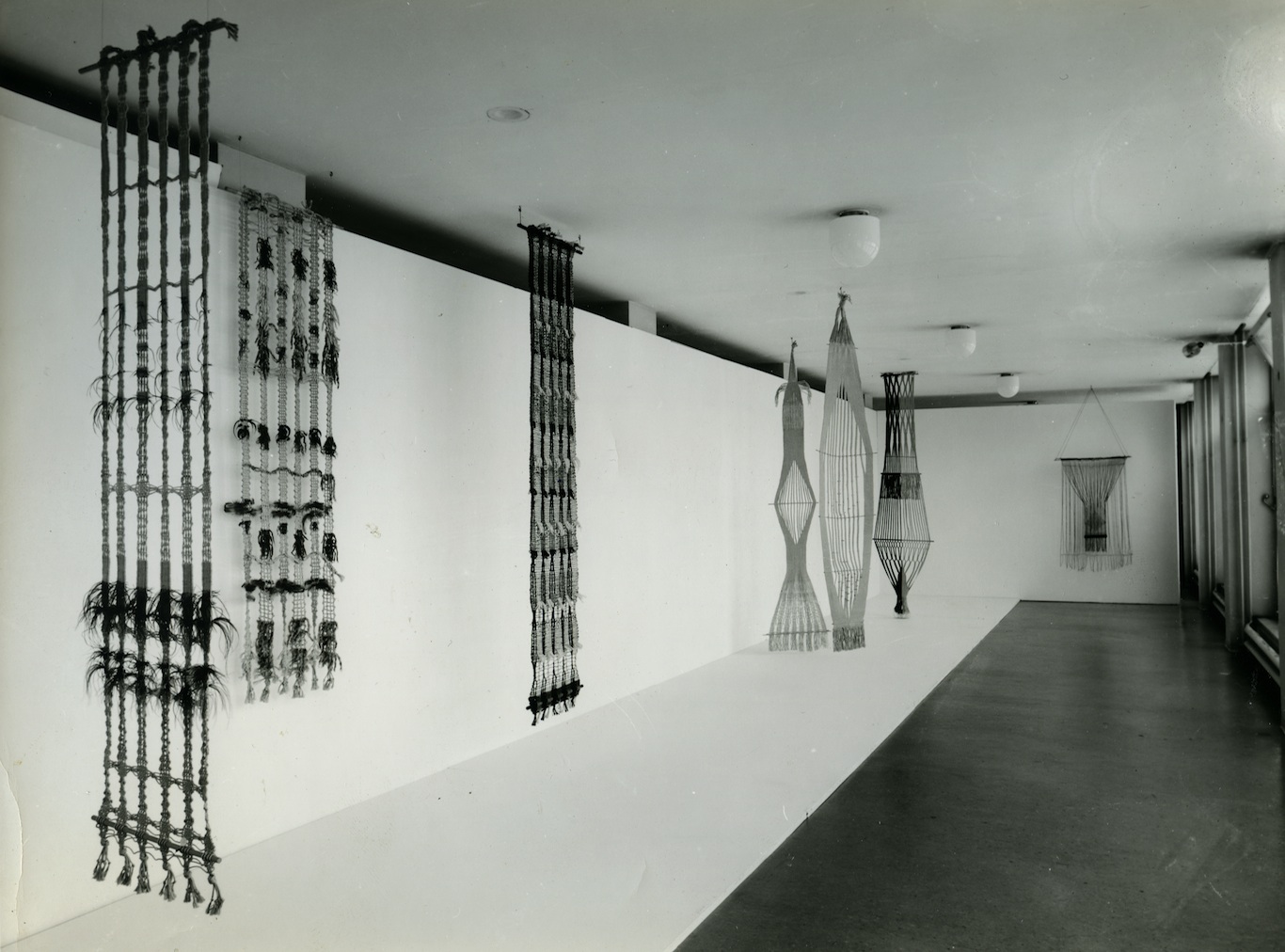
Looking at Lenore Tawney’s extensive oeuvre today, it is easy to believe that her early experiences had a fundamental impact on her creative pursuits in both text and textiles. The truth is that little is known about what informed Tawney’s lifelong art career.
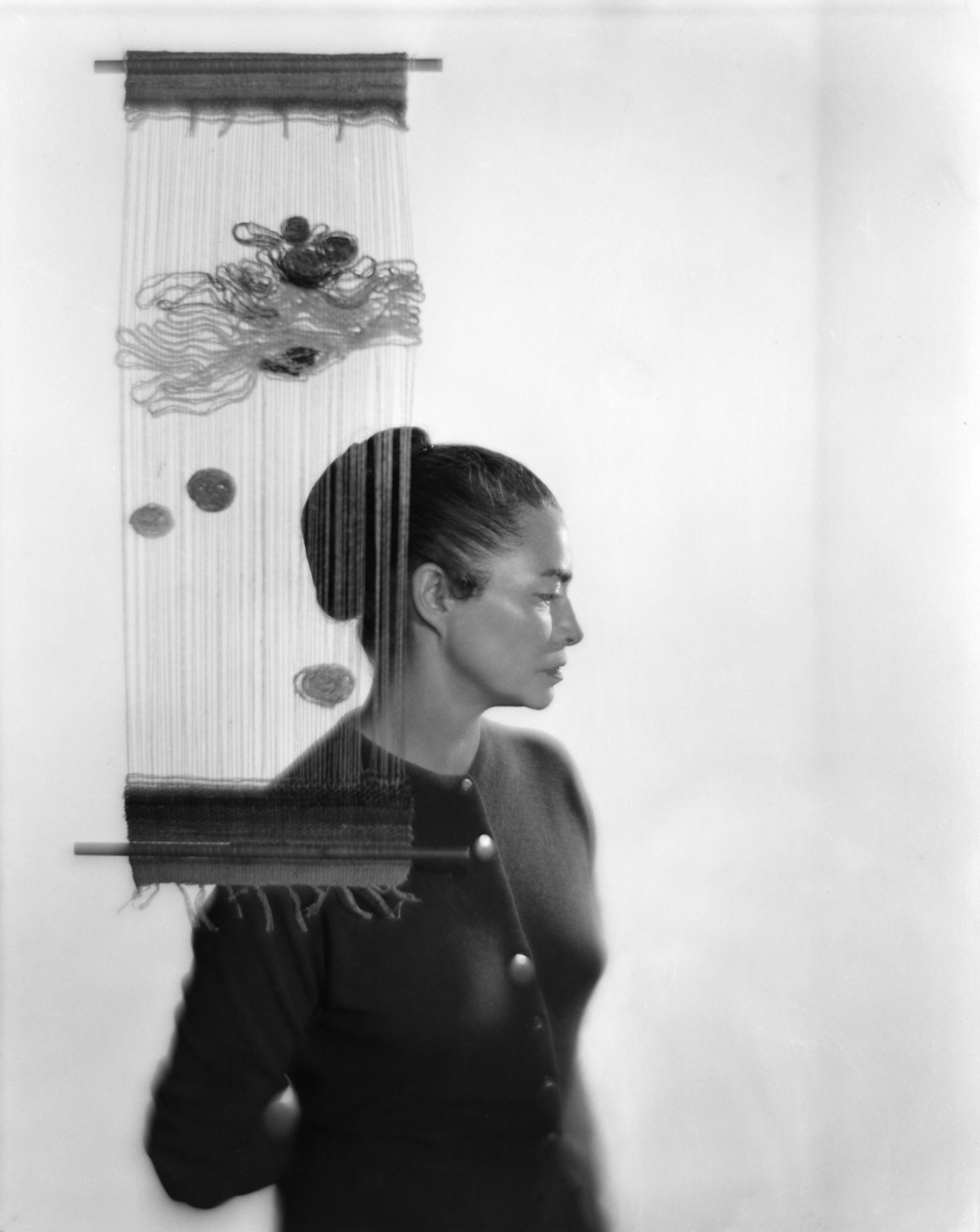
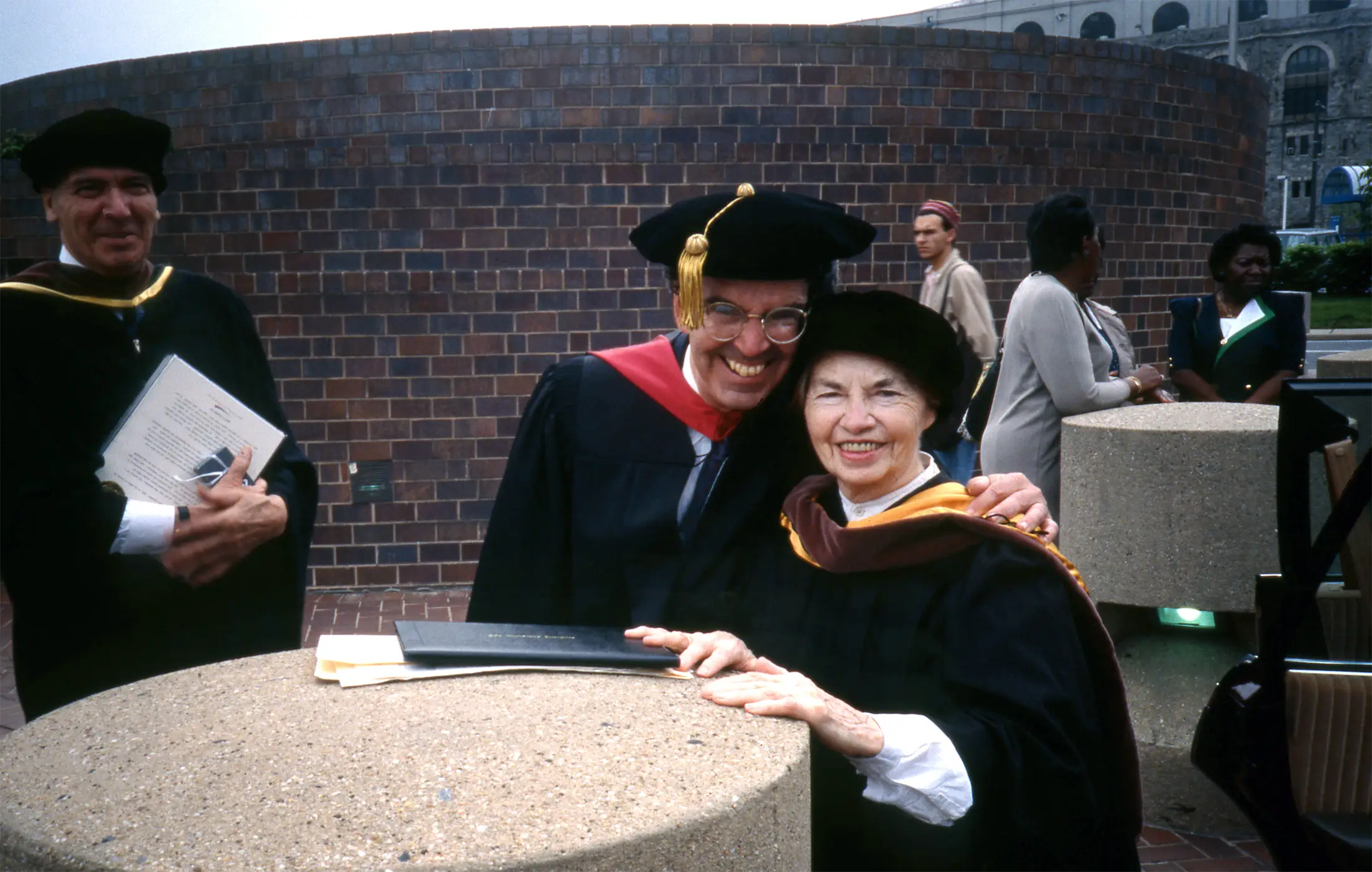
Tawney (1907-2007) was born in Lorain, Ohio. As a young woman, she worked as a seamstress in a menswear factory. She moved to Chicago at twenty and worked as a proofreader at a publishing firm. When she was thirty-six, Tawney’s husband died after just two years of marriage. The young widow enrolled briefly at the University of Illinois, traveled, and in 1946, returned to Chicago where she enrolled in classes at the Institute of Design. There, she studied with acclaimed Bauhaus emigrants Laszlo Moholy-Nagy and Marli Ehrman and art luminaries Alexander Archipenko and Emerson Woelffer.
Her love of buttons and other sewing notions might reference her first job. Her carefully chosen titles and inclusion of poetic sentence fragments could harken back to her years in the publishing industry. Her weavings feel architectural and in sync with the Bauhaus teachings of line, design, and symmetry. Most importantly, her work seems to exude a deeply spiritual aura, one that could only stem from a major loss or life-altering experience.


She left us few clues about those early years. By all accounts, she was not self-effacing, yet she consistently opted not to explain her practice. While there are some clear biographical facts, the reasons for which Tawney made work remain shrouded in mystery. The more one looks at her works—and they all invite deep looking—the more one becomes at peace with this mystery. Experiencing Tawney’s work is akin to meditation, reading a good book, or staring at the ocean. The more time you spend, the more you see, and the more your mind starts to wander to life’s bigger questions. It’s a subtle stilling, and a deepening of experience. And there are not enough available words to explain that feeling.
What is clear, however, is her all-compassing commitment to the life of an artist. She chose to work with techniques that required attentiveness, prompted intuition, and took long stretches of time. Whether it was her weaving, drawing, collage or assemblage, this work insists upon a present-ness and reverence for the process.
In her studio, she surrounded herself with only things that enabled creative work. Despite moving studios four times in a decade, the feel of her space remained the same. Skeins of vibrant threads looped carefully, books with spiritual teachings stacked together, fragile eggs nested in baskets, drawers holding seahorses and other delights, ceramics made by dear friends, and boxes of feathers and other treasures were all at home in Tawney’s airy, serene environment. She both lived and worked in these spaces, further collapsing any boundary between art and life.


This deep commitment to art making came in 1957, when Tawney all but abandoned her comfortable life in Chicago for a new undertaking as a full-time artist in New York. Tawney shed one way of living to build another and over the next fifty years, nurtured an inventive, profoundly personal, life of art-making and spiritual growth.
“I left Chicago,” she wrote in her journal, “to seek a barer life, closer to reality, without all the things that clutter and fill our lives. The truest thing in my life was my work. I wanted my life to be as true.”
Tracing her trajectory from the vibrant weavings of the 1950s to her elegantly shaped woven forms to her large-scale diaphanous Cloud series, this impetus to let go—to undo—is prevalent. With each unconventional weaving, fragile collage, or highly defined line drawing, she redefined what was possible both for herself and for the art world.

In the time she spent making her art, she tuned into an introspective aspect of herself. In her mind, the creative work was to be in service of a meaningful, highly individual life.
Experienced in the present day, Tawney’s works still command a different pace. Their inherent sense of devotion is palpable, and they seem to invite us to slow down, to dig in.
Throughout her life, Tawney made postcards with paper fragments, bones, feathers, shells, and other natural materials. Tawney believed that these impossibly delicate works were not complete until one was sent to someone. Thinking metaphorically, the Tawney’s works act as fragile transmissions, dispatches from an artist who asks us to consider how tenuous it all is, and how important it is to find moments of reverence.
Adapted from In Poetry and Silence: The Work and Studio of Lenore Tawney, curated by Karen Patterson, John Michael Kohler Arts Center, Sheboygan, WI, 2019.